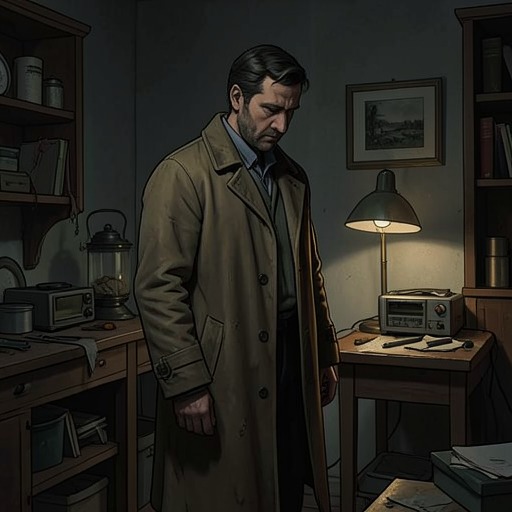
The Illusion of Free Will
Of Human BondageThe Illusion of Free Will is Philip Carey’s attempt to reconcile the powerful feeling of choosing with his belief that actions become inevitable once they have occurred. Developed in conversation with Macalister and tested against Philip’s own experience of passion, the idea challenges the authority of both rational moral rules and retrospective regret. Its central paradox is that the feeling of freedom can influence action even when Philip doubts that the will is free.
The Question Behind the Theory
Philip’s skepticism grows out of experience rather than abstract speculation alone. At a Tuesday evening gathering with Lawson and Hayward, he recalls that the orderly system of thought he had formed at Blackstable had offered little help during his infatuation with Mildred. He had not weighed possible benefits against harms and then selected a course by detached calculation. Instead, he felt his whole being carried toward what it wanted, as though resistance were impossible. Reason, in this account, did not supply the motive; it served the desire by indicating ways of attaining its object.
That recollection complicates any simple claim that passion merely defeats reason. Philip remembers being unable to act against his desire, but also recognizes reason’s practical role in helping him pursue it. His account therefore distinguishes the source of an action from the intellectual means used to carry it out: desire moves the person, while reasoning can become its instrument. The example makes his theory personal and unsettling, because the supposedly general question of freedom is tied to conduct he experienced as both degrading and difficult to escape.
The Dispute with Macalister
Macalister introduces the Categorical Imperative, the proposition that a person should act only according to a rule that could be made universal. Philip rejects the principle as an unreliable guide to life. In his view, it assumes that a person can select a course through an effort of will and gives reason a priority over passion that experience does not justify. Reason and passion may dictate different courses, he argues, but their difference alone does not establish that reason is the better guide.
Philip also refuses to treat Kant’s authority as a reason for accepting Kant’s conclusions. Macalister answers with a sustained dialectical challenge, drawing on his command of arguments and authorities until he has forced Philip into concessions. The exchange is not merely a contest over philosophical doctrine: its pressure exposes how difficult Philip finds it to explain his own experience in terms of free choice. He concedes that he cannot speak for everyone and frames his conclusion as an interpretation of his own mind.
Choice Before Action, Inevitability Afterward
Philip’s formulation holds two apparently opposed beliefs together. Before acting, he experiences a choice among possibilities, and he believes that this strong impression of choice affects what he does. After the act, however, he regards it as having been inevitable from all eternity. The felt possibility matters in the moment, even as hindsight absorbs the completed action into a chain of necessity. His theory does not make the experience of choosing disappear; it makes that experience compatible with a deterministic interpretation of events.
From this account Philip draws a practical conclusion: regret is futile. If all the forces of the universe were directed toward the action that occurred, then wishing afterward that it had gone differently cannot change its necessity. This is not presented as proof that actions carry no consequences, but as a way Philip understands the relation between what happened and what might have happened. His familiar image of spilled milk gives the claim an everyday form: once the event is complete, remorse cannot undo it.
Passion, Freedom, and the Cost of Release
The theory emerges while Philip is discussing his former pursuit of Mildred, and the memory prevents his determinism from seeming emotionally neutral. He remembers the passion as a force that held him fast and recalls the shame and frustration he felt under its influence. He tells himself that he is now free of it, but immediately doubts whether that assurance is sincere. The earlier state had been miserable, yet it had also made him feel unusually vigorous and intensely alive; its disappearance leaves ordinary life comparatively dull.
That contrast gives the concept its human tension. Philip’s account can explain why he should not condemn himself endlessly for actions he now views as inevitable, but it cannot simply erase the suffering attached to those actions. Nor does he treat passion as an uncomplicated liberation: he remembers it as a kind of enslavement, even while recognizing the intensity it brought to experience. The theory thus remains both an intellectual position and a response to the aftermath of an overpowering attachment, with the felt force of choice persisting alongside doubt that choice is ultimately free.